
Stop waiting for someone to "give" you a project leadership opportunity.
A 26-week system for engineers who want to go beyond answering technical questions, and lead the projects they work on.
You're good at your job. So why is nobody giving you projects to lead?
You deliver strong technical work. You see problems others miss. You have insights that could move projects forward.But in meetings, you stay quiet. You're not sure if it's your place to speak. When you do speak up, it doesn't come across the way you intended. Someone tells you to stay in your lane, or less politely, to mind your own business.Meanwhile, you watch less experienced people lead conversations. People with less technical knowledge. People who somehow always seem to know what to say.And you keep waiting. For someone to notice your work. For someone to tap you on the shoulder. For someone to finally give you a chance.That tap on the shoulder you're waiting for?It isn't coming.
The advice you've been given is wrong.
"Just become a better engineer first. Get more experience. Master your discipline. Then you'll be ready for leadership."This sounds logical. It's what we're taught in school, in university, in our jobs. Get more knowledge. Go deeper.But it's complete horseshit.The deeper you go into technical expertise, the further you move from project leadership. The skills are different. And no organization will promote a great technical expert into leadership just because they're technically strong. That's a risk they won't take.There are two engineering career paths:Subject matter expert OR project leader.You don't get the second by doubling down on the first.

Two career paths. One choice.
Subject Matter Expert (SME)
You go deep. You become the person who knows everything about your discipline. When there's a tough technical question, people come to you. You review designs, write standards, solve the hardest problems.Requires:
Deep technical knowledge in one area. Years of specialization. Continuous learning in your discipline.The trade-off:
You answer questions. You don't lead people. Your career ceiling depends on how much your expertise is valued.
Project Leader
You go broad. You become the person who leads people and coordinates chaos. When there's a stuck decision or a room full of confused stakeholders, you step in. You don't need to know every technical detail. You need to know enough to ask the right questions and get the right people talking.Requires: A bit of knowledge across many disciplines. People skills. Leadership behaviours. The ability to read a room and facilitate decisions.The trade-off: You're not the smartest technical person anymore. You're the one who makes smart technical people work together.
Both paths are great career choices. But you can't walk both at the same time.And you don't get the second, by waiting in the first.
More theory ≠ Better Leadership
When I realized I wanted to move into project leadership, I did what engineers do. I researched MBA programs. Made financial plans. Talked to my boss about a sabbatical.I would have spent $100,000 and two years on a master's degree, if I hadn't had a chance conversation with a PM at a conference.He admitted his Masters in Project Management had been useless. Didn't teach him any of the skills he needed to lead people. Only the project management theory you can't apply in most projects anyway because you don't have the resources.That conversation saved me years and six figures.No one tells you how to move beyond being "The Engineer." Annual corporate development plans are mostly pro-forma nonsense. The advice to "just get another master's degree in project management" doesn't teach you people skills.And "just get more experience and eventually you'll be given an opportunity to lead" is toxic. It keeps engineers stuck for years.Leadership opportunities are taken, not given. You must be a leader first. The title only makes it official.
What I learned from a sediment control permit
I once spent six weeks stuck on a sediment control permit.The technical team had submitted everything. The drawings were good, permit requirements were met, as far as we could tell. But the permit just sat there. The city wouldn't issue it, and we couldn't figure out why.I was coordinating this scope, and I knew almost nothing about sediment control. I'm an electrical engineer. Erosion and sediment? Not my world.So I called the city permit officer. And I said something that felt embarrassing at the time:"I'm not nearly the expert you are. Could you explain the issue to me so I understand what I can do to move this forward on my end?"Then I shut up and listened.For the next hour, they walked me through every concern. The water quality issues. The downstream impacts. The fish-bearing creek sediment could drain into. They talked themselves through the whole problem out loud.By the end of the call, they had answered their own questions. Nothing further was needed from our side. I got the permit that afternoon.Six weeks of stalling. One hour of listening. Zero technical knowledge required.
Credibility isn't earned by knowing the answers. It's earned by asking the right questions, being willing to look like a fool sometimes, listening to the answers, and helping people move forward.
Introducing
Project Leadership 101
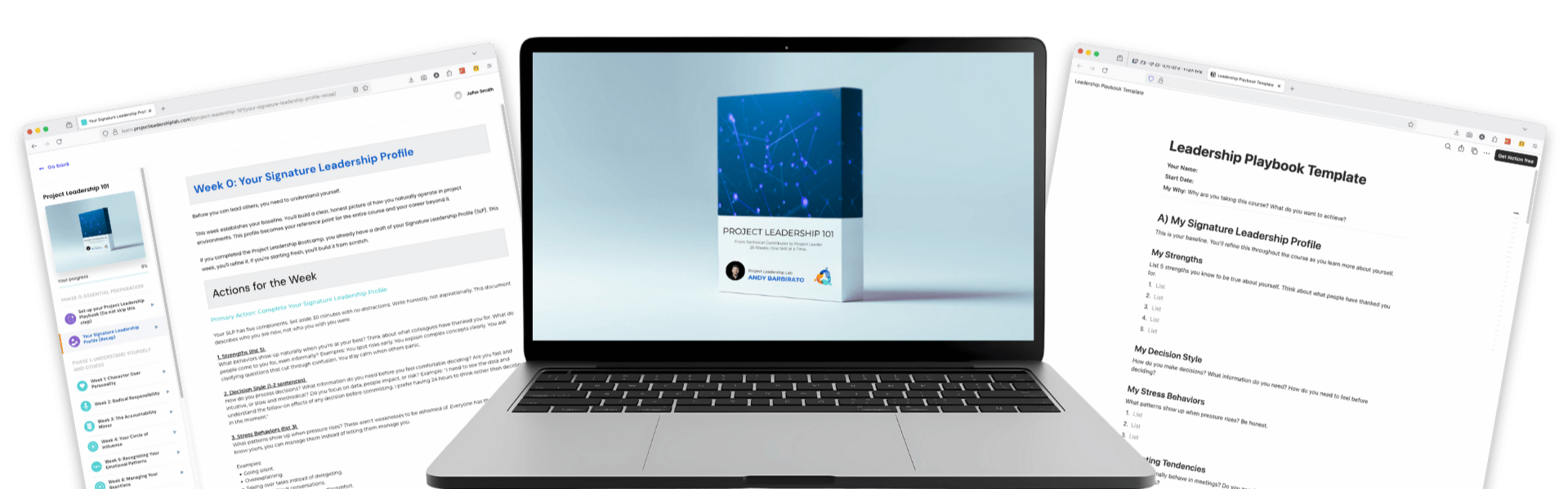
A 26-week Masterclass that takes you from engineer who answers technical questions to engineer who coordinates across disciplines and is positioned for project leadership.
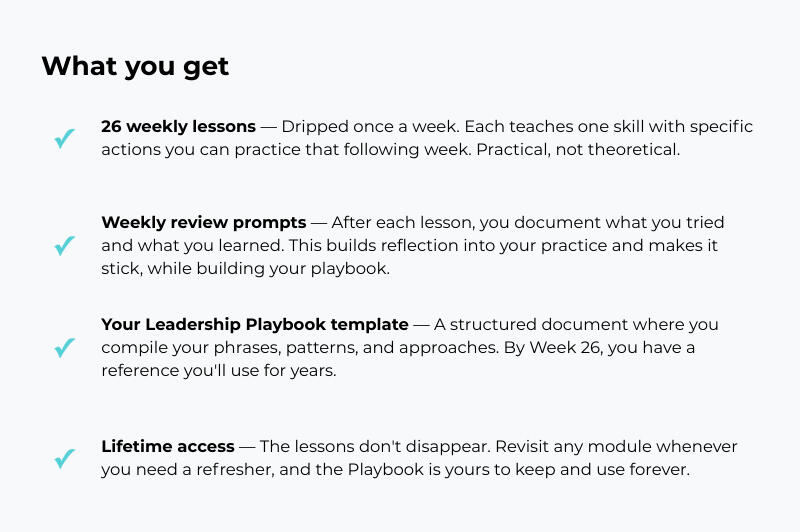
One lesson per week. Each focused on a single skill. Each with specific actions you can practice in your real work environment that week.
By Week 26, you'll have a personal Leadership Playbook. Phrases that work. Patterns you recognize. Approaches for specific situations. A reference you'll use for years.
This course is practice all the way.
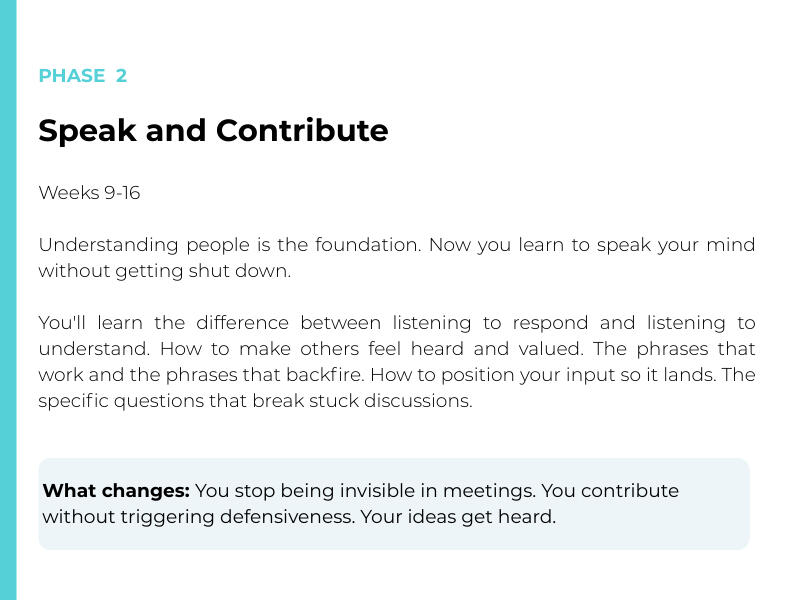
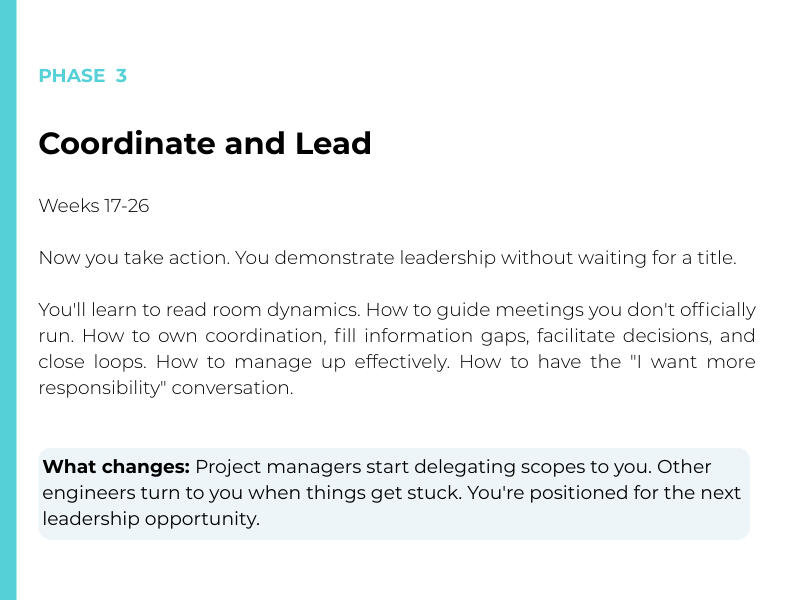
Your transformation happens in 3 Phases



Investment

30-Day Guarantee
Try it for 30 days. Go through the first four lessons. Practice in your real work environment.If you don't feel more confident in your ability to become a project leader, email me and I'll refund every penny. No questions asked.
Why me

Hi - I'm Andy Barbirato.
I help engineers lead projects.
I've been a professional project leader for the last decade. I'm a electrical engineer, licensed in the Province of British Columbia Canada, and currently I lead a $500M Water Infrastructure Project.About a year ago, an engineer asked me after a meeting: "How do you always know what to say?"My answer actually surprised me: I don't care enough about making a mistake to worry about what I'm going to say. I've sat in 5,000+ meetings and learned through experience that as long as you're kind, approachable, and friendly, it makes even tough conversations easier. I've built a set of phrases and approaches I've battle tested. And I don't mind looking like a fool.That last part is the key. I've led scopes I knew nothing about. Sediment control permits. Mechanical systems. Civil engineering. Contract negotiations. I'm an electrical engineer by training. I had no business coordinating half the things I've coordinated.But I learned that asking "Can you explain this to me like I'm 5 years old?" opens more doors than pretending to know, or even actually knowing, the answer.That's 15 years of reps. From the silent engineer in meetings to leading $500M projects with 300 people.This course is the blueprint I wish I had 15 years ago.
You got questions? I got answers
I appreciate a curious mind! So I've gathered the questions I've been asked most below. If these don't cover your questions, email me at [email protected] instead.
I already did the free email bootcamp. Is this different?
The bootcamp gives you the concepts and a few micro-actions to try. This course builds the skills systematically over 26 weeks.Think of the bootcamp as the introduction and PL 101 as the full training program.You'll go deeper into every skill and build a permanent Leadership Playbook you can reference for years.
I'm too junior for leadership. Should I still take this?
If you have 2-7 years of engineering experience, you're not too junior. Leadership visibility doesn't require a title. It comes from demonstrating specific behaviours in meetings you're already attending.The engineers who advance fastest start building these skills early.
Who are you, and why should I trust you?
I'm a professional electrical engineer licensed in the province of British Columbia, Canada.I did most of my education in Austria, born and raised, and Canada, before getting my start in the oil & gas industry as a junior field engineer.I spent the last 10 years moving from technical contributor to now leading a $500M infrastructure projects.I've built oil & gas installations, renewable power plants, power grids, overhead power lines, substations and power plants, hospital annexes, university buildings, roads, tenant improvements, and lots of horizontal infrastructure, mainly water and waste water.I made every mistake you can make in that transition. Stayed quiet when I should have spoken up. Waited for permission instead of taking initiative. Focused only on technical excellence while others got promoted.I learned what actually creates leadership visibility. This course teaches those specific behaviours.
What if I don't have time?
Each lesson takes about 10 minutes to read, and another 20 minutes to do the exercises and reflection.The practice happens in meetings you're already attending.If you can't find 30 minutes once a week to invest in your career, leadership probably isn't the priority right now. And that's okay.
What if I work in a different engineering discipline?
These skills work across all engineering disciplines. Mechanical, electrical, civil, software, chemical, aerospace. The skills that create leadership visibility are behavioural, not technical.Reading rooms, facilitating decisions, coordinating chaos. These apply regardless of your specific engineering focus.
I'm too senior for this. Is it still relevant?
If you're already leading projects successfully, this course probably won't teach you much.But if you're technically strong and wondering why leadership opportunities haven't appeared yet, the gap is behavioural, not technical. That's exactly what this course addresses.
Why monthly payments instead of one payment?
This is a 26-week transformation, not a weekend binge. Monthly payments match the pace of the course and reinforce that this is a process.You're building skills over time, not buying content to forget about.
What happens after 26 weeks?
You keep lifetime access to all lessons. More importantly, you'll have a Leadership Playbook filled with phrases, patterns, and approaches you've personally tested.And you'll be positioned for the next leadership opportunity that opens up.
What's guarantees that this works for me?
You have a full and unconditional 30-day money back guarantee.Try the course, do the first 4 weekly lessons, apply them in your work, and if you determine it's not working for you, simply email [email protected], and you get a full refund and won't be charged again.No questions asked.
Leadership opportunities are taken, not given.
26 weeks. One skill per week. Practice, review, build your playbook.
By the end, you won't be waiting for someone to give you a leadership opportunity. You'll be positioned to take it.
$37/month for 6 months. 30-day money-back guarantee.
© 2026 Project Leadership Lab. All rights reserved.
You are in!
Thank you joining Project Leadership 101.You will receive an email shortly with your receipt and instructions to access your course. If you do not see this email within 24 hours, please check your SPAM folder.If you still did not receive it, please email me (or contact me on LinkedIn, and we'll figure it out.Looking forward to working with you!Andy
© 2026 Project Leadership Lab. All rights reserved.